OUR CHURCH
THE ARMENIAN CHURCH:
A BRIEF INTRODUCTION
The Armenian Apostolic Church is one of the oldest Christian churches in the world, with a history that goes back to the earliest days of Christianity. For centuries, it has played an important role not only in the faith of the Armenian people, but also in preserving Armenian culture, language, and traditions.
According to tradition, Christianity was first brought to Armenia in the 1st century AD by St. Thaddeus and St. Bartholomew, two of the Apostles of Jesus Christ. They preached the Gospel in Armenia and established the first Christian communities. This connection to the Apostles is why the Church is known as the Armenian Apostolic Church.
A major moment in Armenian history came around 301 AD, when King Tiridates III converted to Christianity through the work of St. Gregory the Illuminator. Armenia then became the first nation to officially adopt Christianity as its state religion. St. Gregory became the first Catholicos, or head bishop, of the Armenian Church.
The spiritual center of the Church was established at Holy Etchmiadzin. According to Armenian tradition, St. Gregory had a vision of Christ descending from heaven and showing him the place where the cathedral should be built. The name Etchmiadzin means “the Only-Begotten descended.” The Mother Cathedral of Holy Etchmiadzin remains the spiritual center of the Armenian Apostolic Church today.
Ա Բ Գ
Դ Ե Զ
THE ARMENIAN ALPHABET
Another important moment came in the early 5th century, when St. Mesrop Mashtots created the Armenian alphabet, with the support of Catholicos St. Sahak Partev. The creation of the alphabet made it possible to translate the Bible, prayers, and Christian writings into Armenian. It also helped Armenian Christianity develop in its own language and allowed Armenian literature and education to grow.
As the centuries passed, Armenia went through many periods of foreign rule, war, and political change. During these difficult times, the Church remained one of the most stable institutions in Armenian life. Churches and monasteries became places of worship, but also centers of education, writing, music, art, and community life. The Church helped keep the Armenian language and Christian faith alive even when Armenians did not have an independent country.
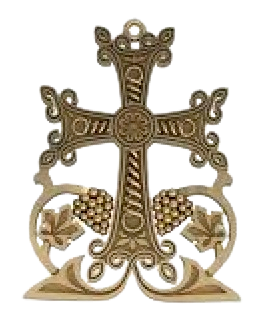
The Armenian Church also developed its own beautiful traditions of worship. Its Divine Liturgy (Badarak), hymns and sharagans, architecture, vestments, crosses, incense, and feast days developed over many centuries. Many of these traditions are still part of Armenian worship today and connect Armenian Christians with generations that came before them.
The Armenian Genocide beginning in 1915 was one of the most difficult periods in the history of the Church and the Armenian people. Countless churches, monasteries, schools, and communities were destroyed, and many clergy and faithful were killed. Survivors carried their faith and traditions with them as they rebuilt their lives and established Armenian communities around the world.
Today, the Armenian Apostolic Church continues to serve communities in Armenia and throughout the diaspora. The Mother See of Holy Etchmiadzin remains its historic spiritual center, while Armenian churches around the world continue the same faith and traditions that have been passed down for centuries.
The history of the Armenian Church is closely tied to the history of the Armenian people. Through times of prosperity as well as hardship, the Church has remained a place where Armenians have gathered to pray, worship, learn, and pass their faith and heritage from one generation to the next.